PICORNAVIRIDAE
Naked, non-segmented, ss (+) RNA. Group IV
General Characteristics
Among the most diverse (about 230 viruses) and the 'oldest' known virus (temple record from Egypt ca. 1400 BC).
Viruses include many important pathogens of humans and animals
Includes first animal virus ever discovered.
Discovered nearly 100 years ago by Loeffler and Frosch.
Includes poliovirus that causes poliomyelitis.
First recognized by Landsteiner and Popper (1909) though the virus was not isolated until the 1930's.
It was the first instance of a large-scale and wide-ranging planned scientific attack by society against a disease.
The plaque assay was developed using poliovirus.
Both RNA dependent RNA polymerase and polyprotein synthesis were discovered by studying poliovirus infected cells.
Virions are insensitive to ether, chloroform, nonionic detergents and other water-immiscible solvents.
Fragile and unstable below pH 7 and some are stabilized by divalent cations.
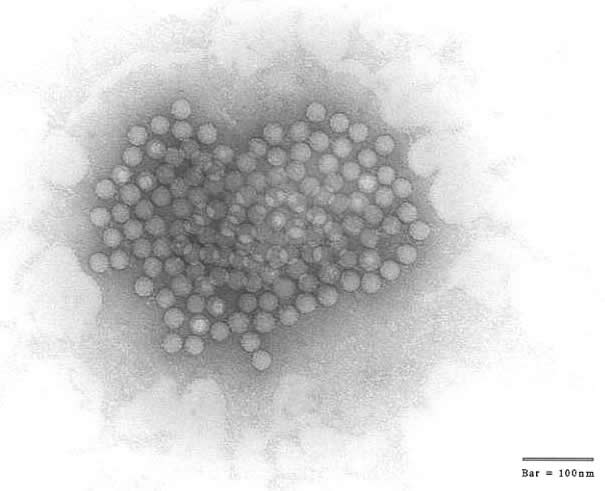
Source: ICTV - Stewart McNulty, Queens University, Belfast.
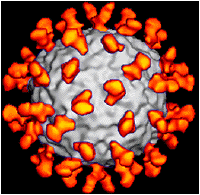
.Source: ICTV - Structure of a rhinovirus
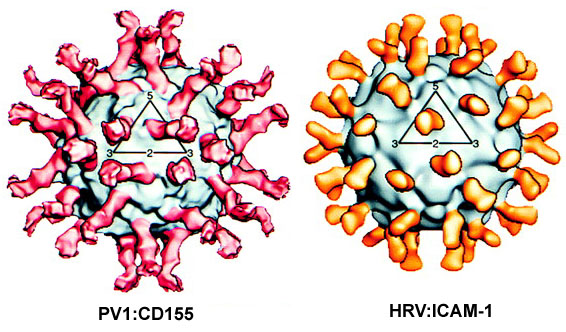
Atomic structure of the receptor-complex of Polio virus 1 and Human Rhinovirus
Source: Rossmann, MG, 2000
Structure
Isomeric virions are 28-30 nm in diameter and are composed of 60 protein subunits (protomers) arranged in icosahedral symmetry.
The capsid consists of 12 capsomers and has a diameter of 27-30 nm, which makes it one of the smallest of all viruses (thus the name "picornavirus").
Virions have a triangulation number of 3, this means that in the icosahedral structure each of the 60 triangles that make up the capsid are split into 3 little triangles with a subunit on the corner.
The capsid has four unique proteins: VP1, 2, 3, and 4.
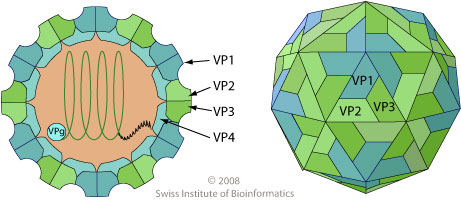
Source: Swiss Institute of Bioinformatics
Taxonomy
Family: Picornaviridae (Gr. pico = very small)
Genera
Enterovirus
Cardiovirus
Rhinovirus
Aphthovirus
Hepatovirus
Genome
Single molecule of linear positive-sense, single-stranded RNA.
The complete genome is 7.1 - 8.9 kb long.
Genome composed of a single ORF encoding a polyprotein
Genome has a 5'-untranslated sequence of variable length, an open reading frame encoding the polyprotein precursor to the structural and non-structural proteins.
A small protein, Vpg, is linked covalently to the 5'-terminus instead of the methylated G cap structure.
There is a long (600 - 1200 nt) unstranslated region (UTR) at the 5'-end which is important in translation, virulence, and possibly encapsidation.
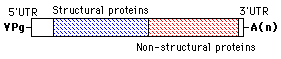
This 5' UTR contains a 'clover leaf' secondary structure known as the IRES (internal ribosome entry site).
Genome has a short 3'-poly (A) tract (50-100 nt) is necessary for (-) strand synthesis during replication.
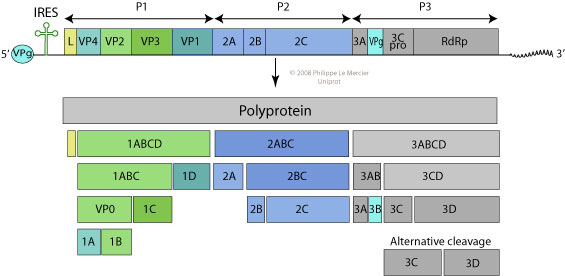
The P1 region encodes the structural polypeptides.
The P2 and P3 regions encode the nonstructural proteins associated with replication.
The rest of the genome encodes a single polyprotein of betwen 2100 and 2400 amino acids.
Virions are constructed from 60 copies each of four capsid proteins and a single copy of the genome linked protein.
The genetic material alone is infectious; although substantially less virulent than if contained within the viral particle.
Source: Swiss Institute of Bioinformatics
Replication
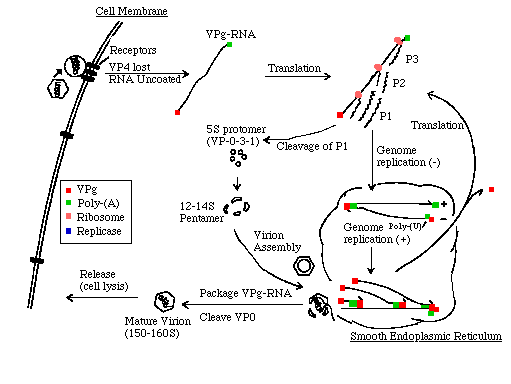
Virus attaches to host receptors (integrins and others) followed by a formation of a coated vesicle.
Uncoating, and release of the viral genomic RNA into the cytoplasm.
VPg is removed from the viral RNA, which is then translated into a processed polyprotein.
RNA replication involves the synthesis of a complementary RNA that serves as a template for genome RNA synthesis.
Translation yields a polyprotein that is cleaved into all the viral proteins, including those that serve as enzymes for specific cleavages.
Replication of viral RNA takes place on membrane vesicles derived from the ER.
Very little is known about the mode of exit of the mature picornavirus particle from the host cell.
Cell lysis and virus release.
Source: Alan Cann 2005.
Transmission
Have narrow host ranges.
Transmission is horizontal, mainly by contact, fecal/oral, or airborne routes.
Diseases
Infection is generally acute and cytolytic, but persistent infections occur with some viruses.
Human Pathogens
Genus Enterovirus -- Their resistance or stability to acid is not understood.
Poliovirus types (PV) 1, PV-2 and PV-3
Human enterovirus A, B, C, D, and E
Coxsackievirus Types A and B
Human echovirus
Genus Rhinovirus
Human rhinovirus A (74 types)
Human rhinovirus B (25 types)Genus Hepatovirus
Hepatitis A virus
Notes on Human Pathogens
Enteroviruses infect the enteric tract as it is visible from its name.
Rhinoviruses infect primarily the nose and the throat.
Enteroviruses replicate at 37°C, whereas rhinoviruses grow better at 33°C, as this is the lower temperature of the nose.
Enteroviruses are stable under acid conditions and thus they are able to survive exposure to gastric acid.
Rhinoviruses are acid-labile and that is the reason why rhinoviruses are restricted to the nose and throat.
Echovirus: Enteric Cytopathic Human Orphan viruses; not linked to any human disease (hence 'orphan'). Common cause of enteric infections.
Animal Pathogens
Genus Enterovirus
Swine vesicular disease virus
Theiler's murine encephalomyelitis virus
Porcine enterovirus
Bovine enterovirus
Simian enterovirus
Genus Cardiovirus
Encephalomyocarditis (EMC) virus
Mengo virus
Genus Rhinovirus
Bovine rhinovirus
Equine rhinovirus
Genus Aphthovirus
Foot-and-mouth disease virus
Genus Hepatovirus
Simian hepatitis A virus